 Names Wallet
Vest
A vesting program for LEZ 0.4 that escrows native LEZ or a token against a schedule and pays the beneficiary on claim, to a public account or straight into a private one.
Live on LEZ 0.4 RC3. Proposal for Logos RFP-017, filed and open.
What it is
- What
- Token vesting on LEZ. A creator locks native LEZ or a LEZ 0.4 token for a beneficiary on a schedule: a cliff then linear, fully linear, or milestones signalled by an authority the creator picks.
- For
- Projects that pay contributors or backers over time, and beneficiaries who want to receive privately.
- Privacy
- With a private claim, anyone can see that a claim happened and its amount, but not which private account received it.
- Parts
- The program, a Rust SDK, the
vestingcommand line (it takes LNS names), the Vest app for Basecamp, a read-only web viewer and the program’s interface file (SPEL v2 IDL). - Signing
- In Basecamp, Vest has no signer of its own. It signs only through Names Wallet: you approve every change there, and Vest never sees a key.
- Source
- github.com/jefdiesel/vest, MIT or Apache-2.0.
- Funding
- Proposal for Logos RFP-017, refiled on 24 November 2026 as logos-co/rfp#295 (superseding #284). Open: nothing has been accepted or awarded.
What you can do with it
- Create a schedule, or several in one transaction.
- Claim what has vested so far, to a public account or straight into a private one.
- Cancel: what has not vested goes back to the creator, and what has vested stays claimable. Or make a schedule irrevocable, for good.
- Hand a schedule to a new beneficiary, if the creator allowed it when creating it.
- Check any schedule: vested, claimed, claimable, locked and the next unlock.
The command line does all of this. The Vest app in Basecamp does it for LEZ schedules, one at a time, with public claims: Names Wallet can’t approve token schedules, private claims or batch creates yet.
In the app, the first screen asks What do you want to do?: Claim tokens sent to me or Pay someone over time, then shows numbered steps. The payout box looks LNS names up as you type, and a balance not read yet shows “Reading…” instead of 0. Vest checks the paying account holds enough before it asks Names Wallet.
Schedules arrive by themselves. Vest’s module reads the chain block by block, one request a second, and finds every schedule that pays your accounts. A schedule someone makes for you shows up in Vest with nothing to paste; pasting a schedule code still works under “Add a schedule by code”. The first full scan of the test network takes a few minutes; later scans only read new blocks.
A left menu groups your schedules: Claimable (with a count), Unvested (with a count, for schedules paying you with nothing to claim yet, shown with “Nothing to claim until” and the date), Paying out and Settings.
Built on the Names Wallet SDK
The Vest app uses the Names Wallet SDK from Names Wallet (λPrize LP-0021). You connect, then create, cancel, make permanent, unlock a milestone, transfer and public claims of LEZ schedules are each approved in Names Wallet, and Names takes you back to Vest. Names Wallet 0.18 lets a program call read the network clock, which is what made creating through the wallet possible.
Names Wallet 0.18.1 (newer than the 0.18.0 test build download) adds a Vesting item to its left menu, listing the same schedules under Claimable now, Unvested and Finished, with Open in Vest. It works without Vest installed (it then says to install Vest).
Screenshots

Rendered from the app. Vest’s first screen: choose what you want to do, then follow the numbered steps. Step 1 connects Names Wallet. An offscreen render of Vest 0.5.4’s screen, made on 21 November 2026, not a screenshot of Basecamp.

Rendered from the app. Paying someone over time. The form says what Names Wallet can’t approve yet, and that Names Wallet opens with the schedule for you to approve. An offscreen render of Vest 0.5.4’s screen, made on 21 November 2026.
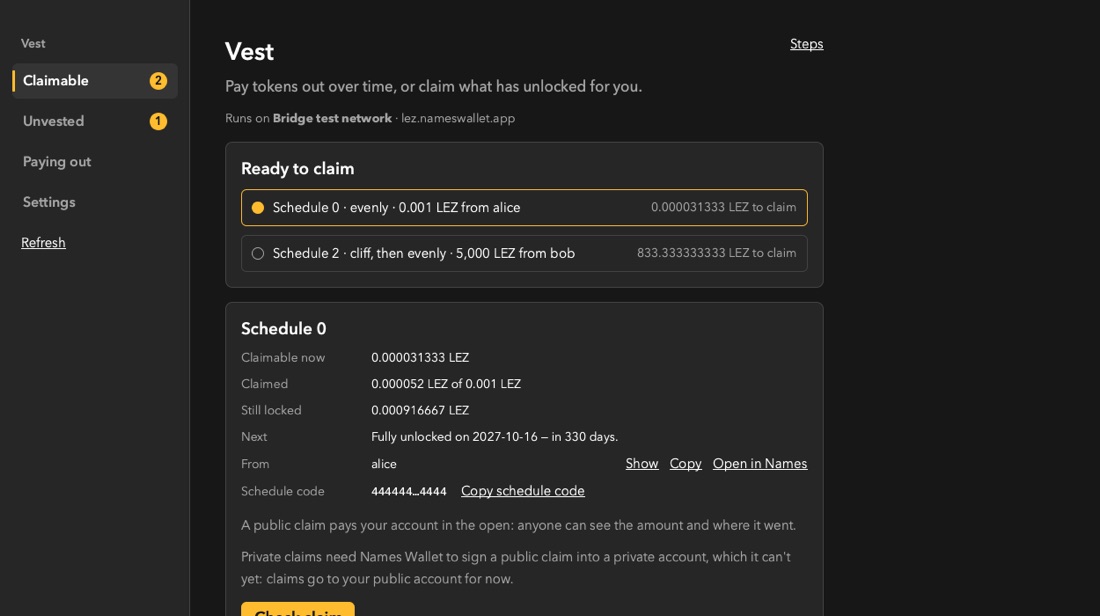
Rendered from the app. Vest’s left menu with counts on Claimable and Unvested, and the details of a claimable schedule. Claims from the app go to a public account for now. Sample data (alice and bob are sample names). An offscreen render of Vest 0.6.1’s screen, made on 21 November 2026, not a screenshot of Basecamp.
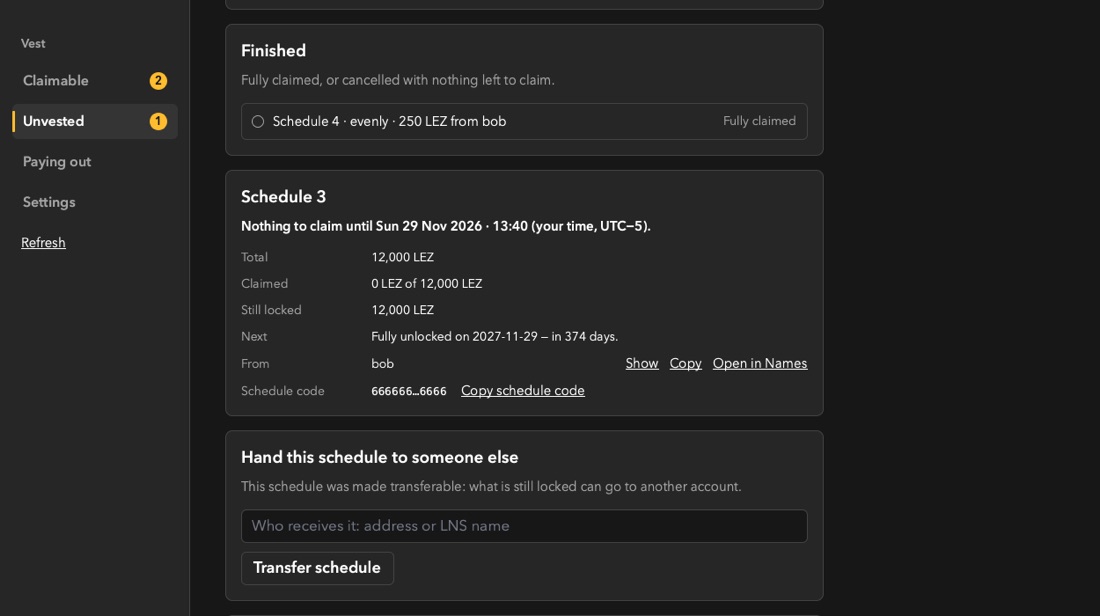
Rendered from the app. An unvested schedule: nothing to claim until the date shown, with the option to transfer a transferable schedule. Sample data (bob is a sample name). An offscreen render of Vest 0.6.1’s screen, made on 21 November 2026, not a screenshot of Basecamp.
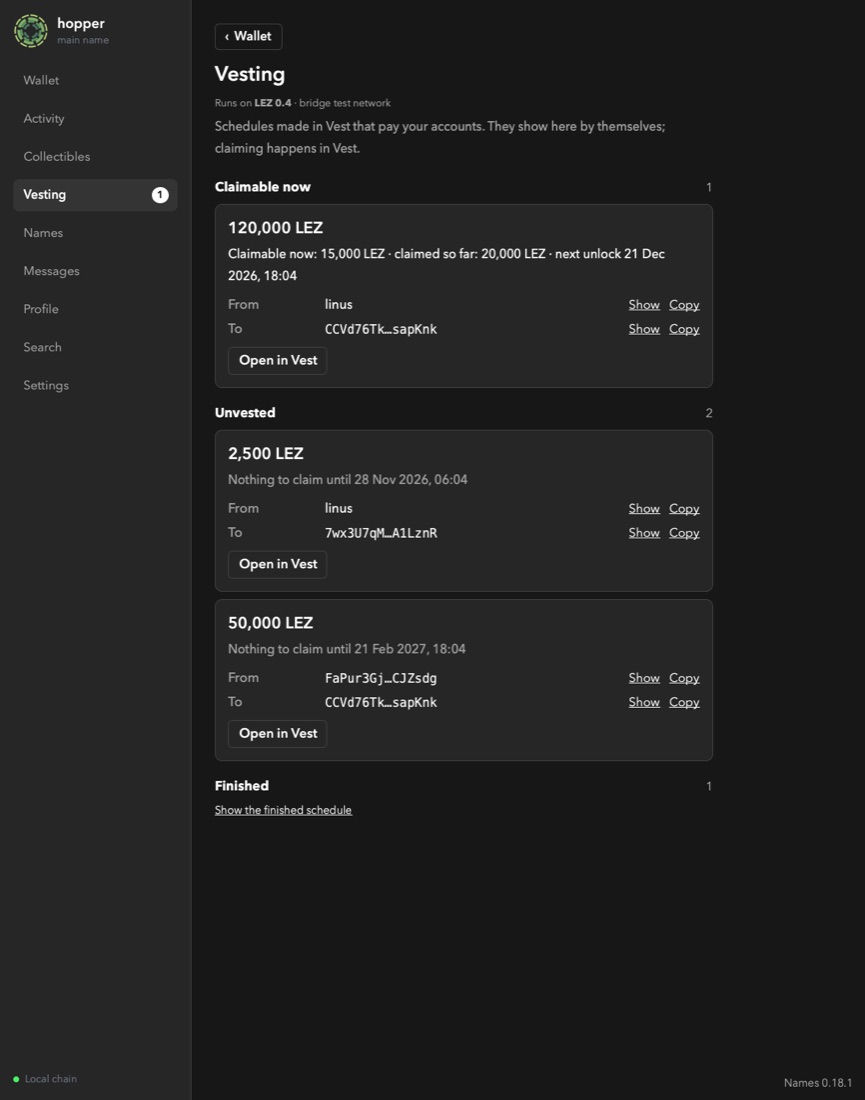
Rendered from the app. Names Wallet 0.18.1’s Vesting page: Claimable now, Unvested and Finished, each linking straight into Vest. Sample data (hopper and linus are sample names). An offscreen render of Names Wallet 0.18.1’s screen, made on 21 November 2026, not a screenshot of Basecamp.
What runs today
Runs on LEZ 0.4 bridge test network. Not on LEZ 0.3.
The program 2kgxMAue…HeM2 runs on LEZ 0.4 RC3 (v0.4.0-rc3), the bridge test network: our own public chain, reset now and then. Every step below opens in our block explorer. Logs: native public lifecycle, tokens and the private claim.
Through Names Wallet, on 21 November 2026:
- A schedule created in the Vest app in Basecamp and approved in Names Wallet:
5f1fdfa2…53e991, block 43932. - Earlier, the calls the Vest module builds, sent through Names Wallet’s send path from its command-line tool, not clicked in Basecamp: a create,
3a3e784b…f32ba8, block 43382; a cancel,8db6c072…6e988e, block 43393, with the refund back to the creator.
From the command line, on 20 November 2026:
- A linear schedule created, then a public claim of 81,385:
1e54efd2…988d12,49b24754…92dee0, blocks 38738 and 38739. - A claim before the cliff refused with the time the cliff ends (code 9); after the cliff, 38,245 claimed:
e409ad49…4a4b54, block 38745. - A cancel: 254,378 back to the creator,
f5f4d374…37574c, block 38746; then the vested 7,377 claimed,26ce7d6e…7502d8, block 38747. - Milestones: one signalled,
add3febe…f84f7d, block 38749; the same one again refused (code 18). - A schedule made irrevocable,
2b3c620d…62acee, block 38751; cancelling it refused (code 14). - The beneficiary changed,
f42caa5d…1144ce, block 38752; the new beneficiary claims 100,000,9e06e2c8…f21dd8, block 38754. - A token claimed into a fresh private account with a real proof: 45,452,
c5d78291…b7b8fd, block 39066. The receiving account is not on chain. - A batch of 8 schedules created in one transaction:
8083542a…d0f0ee, block 39067. - The end-to-end test on a local sequencer: 40 steps passed, none failed (log).
Packages: the Vest app 0.6.3 and its module 0.5.3, installed and working on our test machine (macOS on Apple silicon; app, module). Linux packages (x86_64 and arm64) are built and load-checked on GitHub CI; they have not been rebuilt yet and have not been tried in a Linux Basecamp yet. We plan to rebuild them once, from the final Mac version.
Try it
Try the rules on your own machine first. With no chain options the command line keeps schedules in a JSON file and moves no tokens. It needs Rust.
git clone https://github.com/jefdiesel/vest && cd vest
cargo run -p vesting-cli --bin vesting -- --help
Look up a schedule: any Vest schedule on LEZ 0.4, by schedule account, creator or beneficiary address, or LNS name, read in your browser.
Worked examples (create, check, claim, cancel) are in the README, under Trying the rules offline. To use the live chain, build with the lez feature and pass --network and --wallet; the README says how.
Not done yet
- Token schedules and private claims through Names Wallet. Today they work from the command line only.
- Batch creates through Names Wallet. The command line does them today.
- The Vest app is not in our module catalog yet.
- Nothing runs on a Logos network: LEZ testnet 0.4 is not live yet. A reset of our chain would wipe these runs.
- Independent review (milestone 3) has not happened. Nothing is audited. Test coins only.
From the proposal (#295), the repository’s README, user guide and docs/live/, and the Names Wallet SDK page, read on 21 November 2026; each transaction read back from the chain that day.